
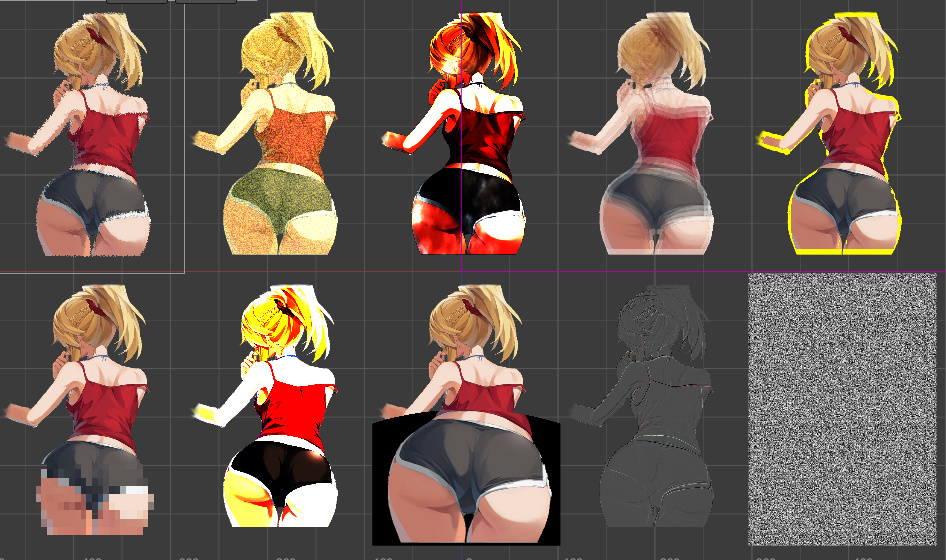
放下图,这都是几个闲着没事从网上搜罗的奇奇怪怪的效果。
// Copyright (c) 2017-2018 Xiamen Yaji Software Co., Ltd.

CCEffect %{
  techniques:
  - passes:
    - vert: vs
      frag: fs
      blendState:
        targets:
        - blend: true
      rasterizerState:
        cullMode: none
      properties:
        texture: {  value: white }
        texture2: {  value: white }
        u_time: {value: 1}
        u_mouse: {value: [1.0, 1.0]}
}%


CCProgram vs %{
precision highp float;

#include <cc-global>
#include <cc-local>

attribute vec3 a_position;
attribute lowp vec4 a_color;
attribute mediump vec2 a_uv0;

varying mediump vec2 v_uv0;
varying lowp vec4 v_color;
varying lowp vec4 v_wp;

 void main () {
   mat4 mvp;
   mvp = cc_matViewProj;
   v_color = a_color;
   gl_Position = mvp * vec4(a_position, 1);
   v_wp = cc_matWorld * vec4(a_position, 1);

   v_uv0 = a_uv0;
 }

}%


CCProgram fs %{
precision mediump float;

uniform sampler2D texture;
uniform sampler2D texture2;

uniform Constants1 {
  vec2 u_mouse;
  float u_time;
};

varying mediump vec2 v_uv0;
varying lowp vec4 v_color;
varying lowp vec4 v_wp;


#define resolution vec2(960.,640.)
#define u_resolution resolution
#define time u_time
#define iResolution resolution
#define iTime time

#define fragColor gl_FragColor
#define fragCoord gl_FragCoord
#define iMouse u_mouse
#define PI 3.14159265358979323846
#define MYUV vec2 uv = vec2(1. - v_uv0.x,v_uv0.y);vec2 st = uv;

// Precision-adjusted variations of https://www.shadertoy.com/view/4djSRW
#define NOISE fbm
#define NUM_NOISE_OCTAVES 5
float hash(float p) { p = fract(p * 0.011); p *= p + 7.5; p *= p + p; return fract(p); }
float hash(vec2 p) {vec3 p3 = fract(vec3(p.xyx) * 0.13); p3 += dot(p3, p3.yzx + 3.333); return fract((p3.x + p3.y) * p3.z); }

float noise(float x) {
    float i = floor(x);
    float f = fract(x);
    float u = f * f * (3.0 - 2.0 * f);
    return mix(hash(i), hash(i + 1.0), u);
}


float noise(vec2 x) {
    vec2 i = floor(x);
    vec2 f = fract(x);

	// Four corners in 2D of a tile
	float a = hash(i);
    float b = hash(i + vec2(1.0, 0.0));
    float c = hash(i + vec2(0.0, 1.0));
    float d = hash(i + vec2(1.0, 1.0));

    // Simple 2D lerp using smoothstep envelope between the values.
	// return vec3(mix(mix(a, b, smoothstep(0.0, 1.0, f.x)),
	//			mix(c, d, smoothstep(0.0, 1.0, f.x)),
	//			smoothstep(0.0, 1.0, f.y)));

	// Same code, with the clamps in smoothstep and common subexpressions
	// optimized away.
    vec2 u = f * f * (3.0 - 2.0 * f);
	return mix(a, b, u.x) + (c - a) * u.y * (1.0 - u.x) + (d - b) * u.x * u.y;
}


float noise(vec3 x) {
    const vec3 step = vec3(110, 241, 171);

    vec3 i = floor(x);
    vec3 f = fract(x);

    // For performance, compute the base input to a 1D hash from the integer part of the argument and the
    // incremental change to the 1D based on the 3D -> 1D wrapping
    float n = dot(i, step);

    vec3 u = f * f * (3.0 - 2.0 * f);
    return mix(mix(mix( hash(n + dot(step, vec3(0, 0, 0))), hash(n + dot(step, vec3(1, 0, 0))), u.x),
                   mix( hash(n + dot(step, vec3(0, 1, 0))), hash(n + dot(step, vec3(1, 1, 0))), u.x), u.y),
               mix(mix( hash(n + dot(step, vec3(0, 0, 1))), hash(n + dot(step, vec3(1, 0, 1))), u.x),
                   mix( hash(n + dot(step, vec3(0, 1, 1))), hash(n + dot(step, vec3(1, 1, 1))), u.x), u.y), u.z);
}


float fbm(float x) {
	float v = 0.0;
	float a = 0.5;
	float shift = float(100);
	for (int i = 0; i < NUM_NOISE_OCTAVES; ++i) {
		v += a * noise(x);
		x = x * 2.0 + shift;
		a *= 0.5;
	}
	return v;
}


float fbm(vec2 x) {
	float v = 0.0;
	float a = 0.5;
	vec2 shift = vec2(100);
	// Rotate to reduce axial bias
    mat2 rot = mat2(cos(0.5), sin(0.5), -sin(0.5), cos(0.50));
	for (int i = 0; i < NUM_NOISE_OCTAVES; ++i) {
		v += a * noise(x);
		x = rot * x * 2.0 + shift;
		a *= 0.5;
	}
	return v;
}


float fbm(vec3 x) {
	float v = 0.0;
	float a = 0.5;
	vec3 shift = vec3(100);
	for (int i = 0; i < NUM_NOISE_OCTAVES; ++i) {
		v += a * noise(x);
		x = x * 2.0 + shift;
		a *= 0.5;
	}
	return v;
}


void main() {
  MYUV;
    vec3 color = vec3(0.0);
    vec4 tex = texture2D(texture,uv);
    float ffbm = fbm(st*3.0+fbm(st*3.+fbm(st*3.)));
    float noiseval = noise(uv * 500.);
    vec3 colorhuang = vec3(1.,1.,0.);
#if EFFECT1
    color = vec3(1.0);
#elif EFFECT2
    float off = .02 * (noiseval * .5 - 0.5);
    float mul = 0.2;
    color += texture2D(texture,uv + vec2(off,off)).xyz * mul;
    color += texture2D(texture,uv + vec2(-off,off)).xyz * mul;
    color += texture2D(texture,uv + vec2(off,-off)).xyz * mul;
    color += texture2D(texture,uv + vec2(-off,-off)).xyz * mul;
    color += texture2D(texture,uv + vec2(0.,0.)).xyz * mul;

    color = texture2D(texture,uv + vec2(off)).xyz;
    tex.a = texture2D(texture,uv + vec2(off)).a;

    //tex.a = 1.;
#elif EFFECT3
    noiseval = noise(uv * 400.);
    color += tex.xyz;
    color += vec3(noiseval) * vec3(1.,1.,.0) * .5;
#elif EFFECT4
    noiseval = fbm(uv * 8.);

    color += tex.xyz;
    color *= tex.a;
    color = mix(color, vec3(noiseval),noiseval);
    color = pow(color * 10., vec3(10.)) * 0.00000001;
#elif EFFECT5
    float off = .02;
    float mul = 0.2;
    color += texture2D(texture,uv + vec2(off,off)).xyz * mul;
    color += texture2D(texture,uv + vec2(-off,off)).xyz * mul;
    color += texture2D(texture,uv + vec2(off,-off)).xyz * mul;
    color += texture2D(texture,uv + vec2(-off,-off)).xyz * mul;
    color += texture2D(texture,uv + vec2(0.,0.)).xyz * mul;
#elif EFFECT6
    float sum = 0.;
    float off = 0.02;
    sum += texture2D(texture,uv + vec2(off,off)).a;
    sum += texture2D(texture,uv + vec2(-off,off)).a;
    sum += texture2D(texture,uv + vec2(off,-off)).a;
    sum += texture2D(texture,uv + vec2(-off,-off)).a;
    sum += texture2D(texture,uv + vec2(0.,0.)).a;

    float checkf = 3.5;
    float n = smoothstep(.3,checkf * .5,sum) - smoothstep(checkf * .5,checkf,sum);
    n = step(.1,n);
    color = mix(colorhuang,tex.xyz,1. - n);
#elif EFFECT7
    vec2 uv7 = uv * 10000.;
    uv7 = uv7 - mod(uv7,300.);
    uv7 *= 0.0001;

    tex = texture2D(texture,uv7);
    color = tex.xyz;

    float p = step(uv.y,0.7);

    color = mix(color,texture2D(texture,uv).xyz,p);

    tex.a = mix(tex.a,texture2D(texture,uv).a,p);

#elif EFFECT8
    color = tex.xyz;
    color = pow(color * 2.6,vec3(10.));
    color *= 0.2;

#elif EFFECT9
    float n = 960./640.;
    n = 591./200.;

    color = tex.xyz;

    vec2 p = vec2(0.5,0.8);
    float r = 0.3;
    vec2 off = uv - p;
    //off.x /= n;
    float d = length(vec2(off.x/n,off.y));
    d = step(d,r);

    vec2 uv9 = p + off * 0.7;
    vec4 tex9 = texture2D(texture,uv9);
    color = tex9.xyz * tex9.a;
    tex.a = max(tex.a, d );
    color = mix( texture2D(texture,uv).xyz, color, d );
    //tex.a = 1.;
#elif EFFECT10
    color = tex.xyz;
    color -= texture2D(texture,uv - 0.001).xyz;
    color += .3;
#elif EFFECT11
    color = vec3(noiseval);
    tex.a = 1.;
#elif EFFECT12
#elif EFFECT13
#elif EFFECT14
#elif EFFECT15
#elif EFFECT16
#elif EFFECT17
#elif EFFECT18

#else
    color = vec3(.6);
#endif
    gl_FragColor = vec4(color,tex.a);
}
}%
要周末了,偷下懒,有兴趣的自己试一下吧,有问题回头再聊。
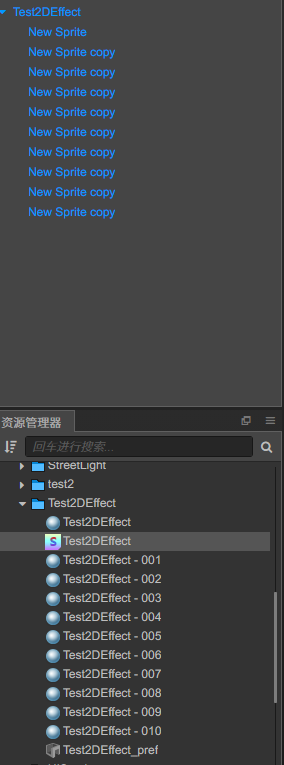
一个图对一个材质,不同材质就是勾选的宏不一样,自己搞起来试试吧,都是挺简单的。
不懂原理的基本都可以看对应效果去百度到。都很简单的东西,造型都不需要的。
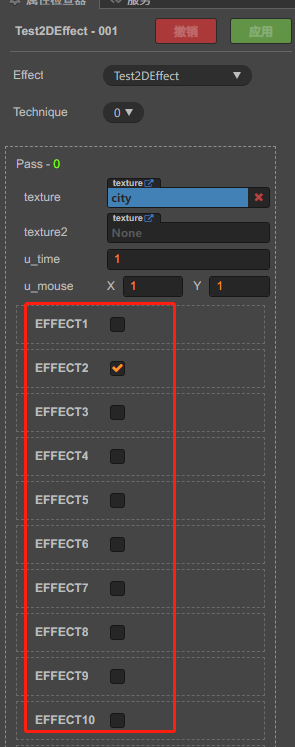
应该前9个宏都有意义的。老库存了,比较鸡肋,只能练手用的。
