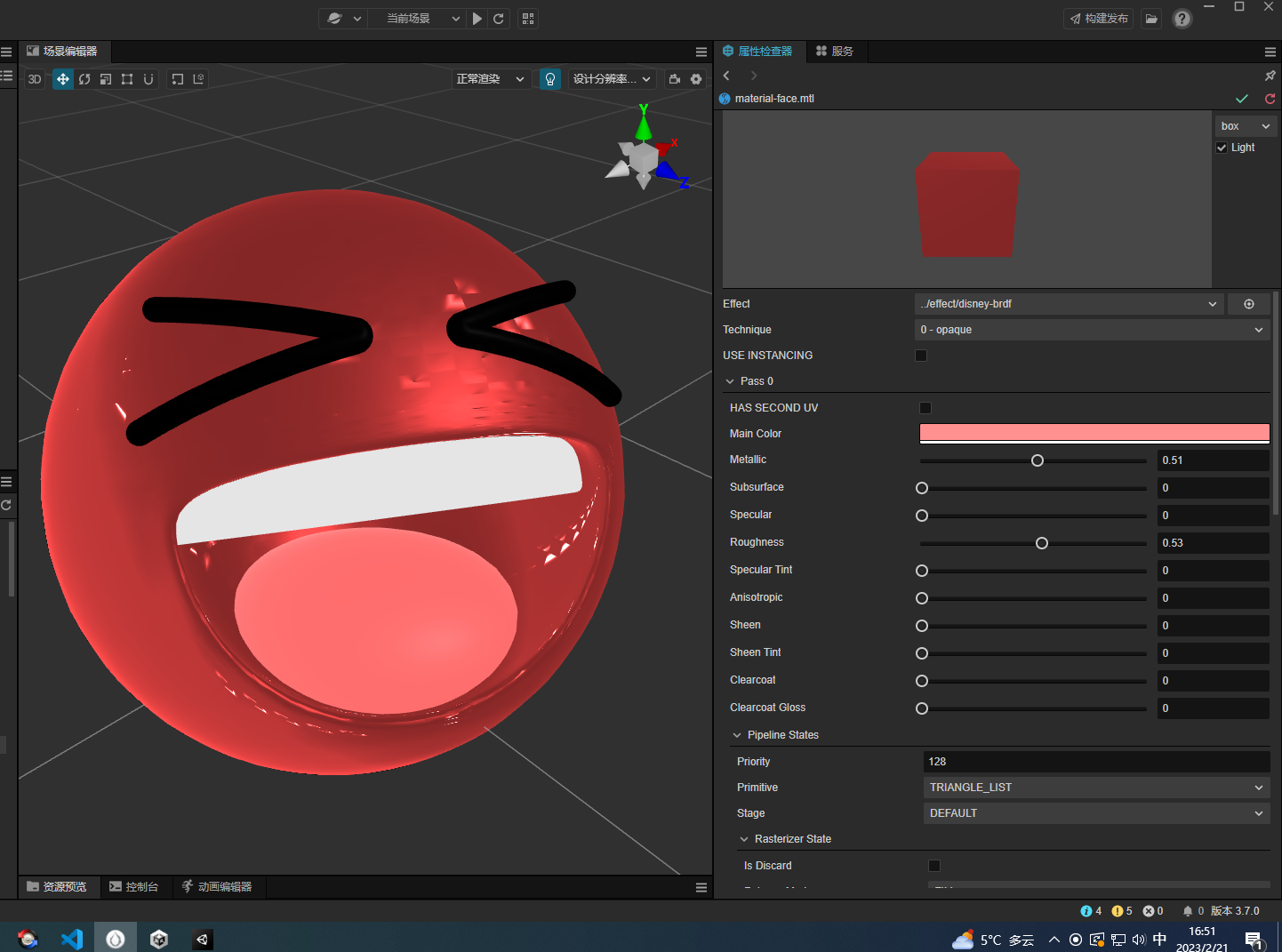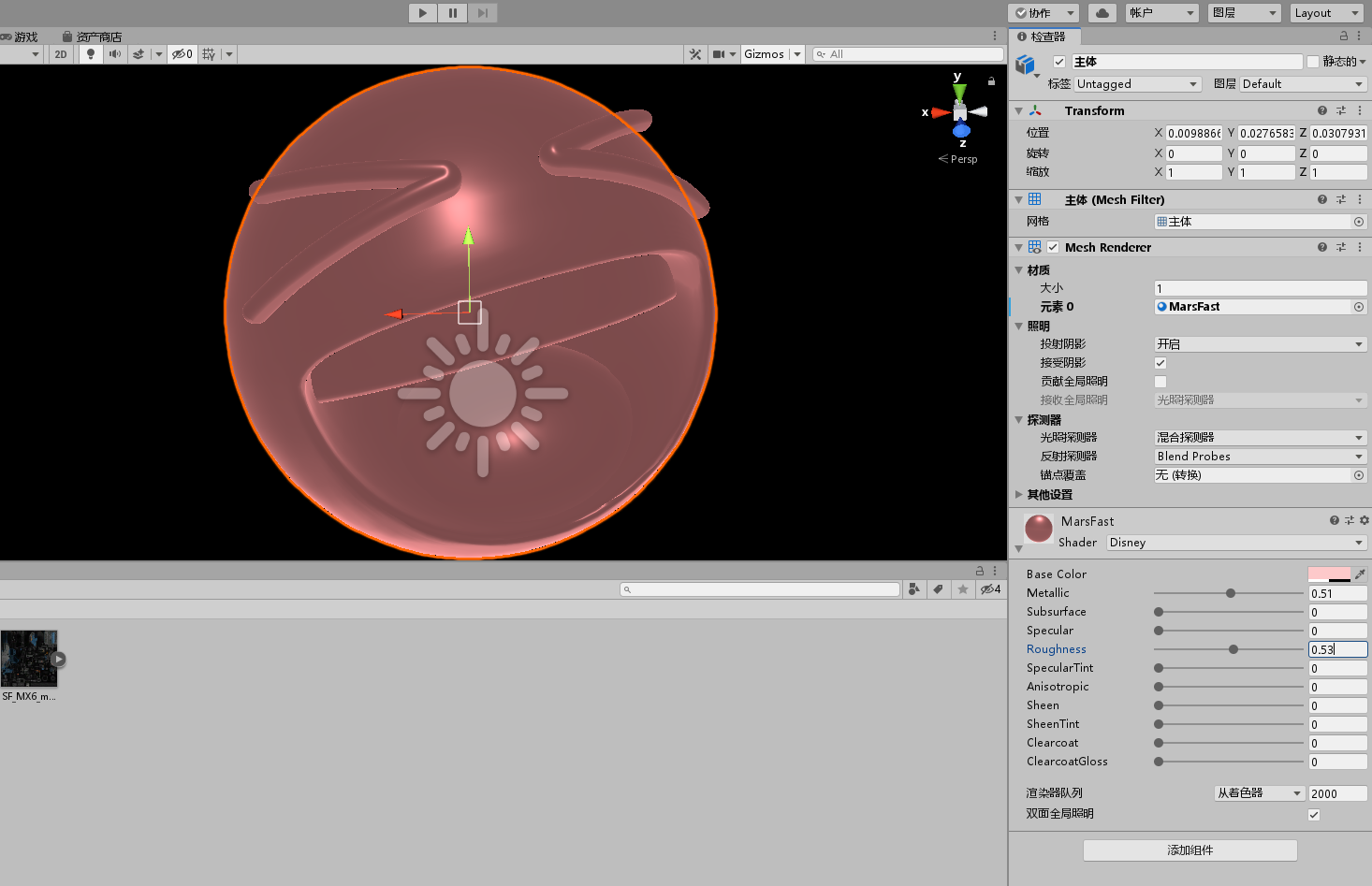
我在Cocos和Unity写了相同算法的Shader
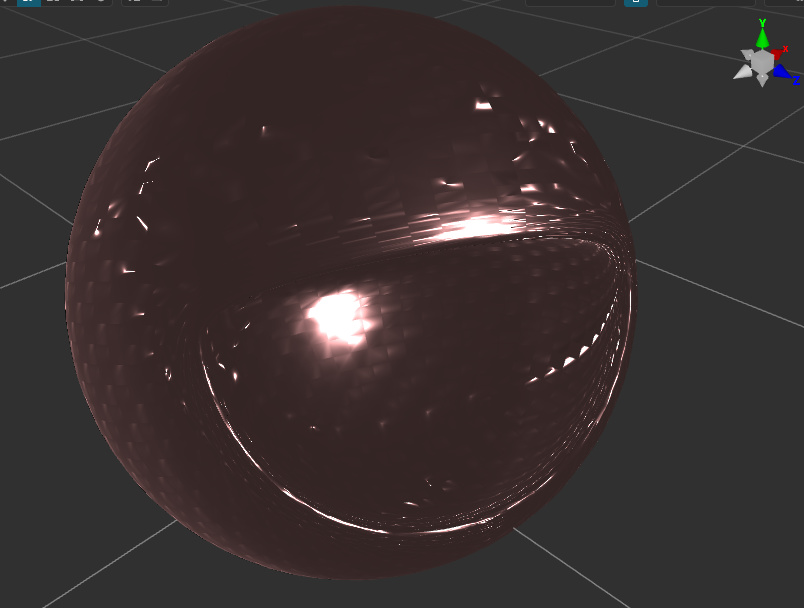
在Cocos中表现:
代码
// Effect Syntax Guide: https://docs.cocos.com/creator/manual/zh/shader/index.html

CCEffect %{
  techniques:
  - name: opaque
    passes:
    - vert: general-vs:vert # builtin header
      frag: disney-fs:frag
      properties: &props
        # mainTexture:        { value: white }
        mainColor:          { value: [1, 1, 1, 1], editor: { type: color } }
        metallic:           { value: 0.0, editor: {slide: true, range: [0,  1.0], step: 0.01}}
        subsurface:         { value: 0.0, editor: {slide: true, range: [0,  1.0], step: 0.01}}
        specular:           { value: 0.5, editor: {slide: true, range: [0,  1.0], step: 0.01}}
        roughness:          { value: 0.5, editor: {slide: true, range: [0,  1.0], step: 0.01}}
        specularTint:       { value: 0.0, editor: {slide: true, range: [0,  1.0], step: 0.01}}
        anisotropic:        { value: 0.0, editor: {slide: true, range: [0,  1.0], step: 0.01}}
        sheen:              { value: 0.0, editor: {slide: true, range: [0,  1.0], step: 0.01}}
        sheenTint:          { value: 0.5, editor: {slide: true, range: [0,  1.0], step: 0.01}}
        clearcoat:          { value: 0.0, editor: {slide: true, range: [0,  1.0], step: 0.01}}
        clearcoatGloss:     { value: 1.0, editor: {slide: true, range: [0,  1.0], step: 0.01}}
}%

CCProgram disney-fs %{
  precision highp float;
  #include <builtin/uniforms/cc-global>
  #include <legacy/output>
  #include <legacy/fog-fs>

  in vec2 v_uv;
  in vec3 v_normal;
  in vec3 v_position;
  in vec3 v_tangent;
  in vec3 v_bitangent;
  uniform sampler2D mainTexture;
  const float PI = 3.14159265358979323846;

  uniform Constant {
    vec4 mainColor;
    float metallic;
    float subsurface;
    float specular;
    float roughness;
    float specularTint;
    float anisotropic;
    float sheen;
    float sheenTint;
    float clearcoat;
    float clearcoatGloss;
  };

  float sqr(float x) { return x*x; }

  float SchlickFresnel(float u)
  {
      float m = clamp(1.0-u, 0.0, 1.0);
      float m2 = m*m;
      return m2*m2*m; // pow(m,5)
  }

  float GTR1(float NdotH, float a)
  {
      if (a >= 1.0) return 1.0/PI;
      float a2 = a*a;
      float t = 1.0 + (a2-1.0)*NdotH*NdotH;
      return (a2-1.0) / (PI*log(a2)*t);
  }

  float GTR2(float NdotH, float a)
  {
      float a2 = a*a;
      float t = 1.0 + (a2-1.0)*NdotH*NdotH;
      return a2 / (PI * t*t);
  }

  float GTR2_aniso(float NdotH, float HdotX, float HdotY, float ax, float ay)
  {
      return 1.0 / (PI * ax*ay * sqr( sqr(HdotX/ax) + sqr(HdotY/ay) + NdotH*NdotH ));
  }

  float smithG_GGX(float NdotV, float alphaG)
  {
      float a = alphaG*alphaG;
      float b = NdotV*NdotV;
      return 1.0 / (NdotV + sqrt(a + b - a*b));
  }

  float smithG_GGX_aniso(float NdotV, float VdotX, float VdotY, float ax, float ay)
  {
      return 1.0 / (NdotV + sqrt( sqr(VdotX*ax) + sqr(VdotY*ay) + sqr(NdotV) ));
  }

  vec3 mon2lin(vec3 x)
  {
      return vec3(pow(x[0], 2.2), pow(x[1], 2.2), pow(x[2], 2.2));
  }

  vec3 BRDF( vec3 L, vec3 V, vec3 N, vec3 X, vec3 Y )
  {
      // 法线和光线的夹角
      float NdotL = max(dot(N,L), 0.0);
      // 法线和视线的夹角
      float NdotV = max(dot(N,V), 0.0);
      // 半角向量
      vec3 H = normalize(L+V);

      float NdotH = max(dot(N,H), 0.0);
      float LdotH = max(dot(L,H), 0.0);

      vec3 Cdlin = mon2lin(mainColor.rgb);
      float Cdlum = .3*Cdlin[0] + .6*Cdlin[1]  + .1*Cdlin[2]; // luminance approx.

      vec3 Ctint = Cdlum > 0.0 ? Cdlin/Cdlum : vec3(1.0,1.0,1.0); // normalize lum. to isolate hue+sat
      vec3 Cspec0 = mix(specular*.08*mix(vec3(1.0,1.0,1.0), Ctint, specularTint), Cdlin, metallic);
      vec3 Csheen = mix(vec3(1.0,1.0,1.0), Ctint, sheenTint);

      // Diffuse fresnel - go from 1 at normal incidence to .5 at grazing
      // and mix in diffuse retro-reflection based on roughness
      float FL = SchlickFresnel(NdotL), FV = SchlickFresnel(NdotV);
      float Fd90 = 0.5 + 2.0 * LdotH * LdotH * roughness;
      float Fd = mix(1.0, Fd90, FL) * mix(1.0, Fd90, FV);

      // Based on Hanrahan-Krueger brdf approximation of isotropic bssrdf
      // 1.25 scale is used to (roughly) preserve albedo
      // Fss90 used to "flatten" retroreflection based on roughness
      float Fss90 = LdotH*LdotH*roughness;
      float Fss = mix(1.0, Fss90, FL) * mix(1.0, Fss90, FV);
      float ss = 1.25 * (Fss * (1.0 / (NdotL + NdotV) - .5) + .5);

      // specular
      float aspect = sqrt(1.0-anisotropic*.9);
      float ax = max(.001, sqr(roughness)/aspect);
      float ay = max(.001, sqr(roughness)*aspect);
      float Ds = GTR2_aniso(NdotH, dot(H, X), dot(H, Y), ax, ay);
      float FH = SchlickFresnel(LdotH);
      vec3 Fs = mix(Cspec0, vec3(1.0,1.0,1.0), FH);
      float Gs = smithG_GGX_aniso(NdotL, dot(L, X), dot(L, Y), ax, ay);
      Gs *= smithG_GGX_aniso(NdotV, dot(V, X), dot(V, Y), ax, ay);

      // sheen
      vec3 Fsheen = FH * sheen * Csheen;

      // clearcoat (ior = 1.5 -> F0 = 0.04)
      float Dr = GTR1(NdotH, mix(.1,.001,clearcoatGloss));
      float Fr = mix(.04, 1.0, FH);
      float Gr = smithG_GGX(NdotL, .25) * smithG_GGX(NdotV, .25);

      return (mix(Fd, ss, subsurface)*Cdlin + Fsheen) * (1.0-metallic)+ Gs*Fs*Ds + .25*clearcoat*Gr*Fr*Dr;
  }

  vec4 frag () {
    // 光源方向
    vec3 lightDirection = normalize(-cc_mainLitDir.xyz);
    // 视线方向
    vec3 viewDirection = normalize(cc_cameraPos.xyz - v_position);
    // 法线方向
    vec3 normalDirection = normalize(v_normal);
    vec3 worldTangent = normalize(v_tangent);
    vec3 worldBinormal = normalize(v_bitangent);
    return vec4(BRDF(lightDirection, viewDirection, normalDirection, worldTangent, worldBinormal), 1.0);
  }
}%
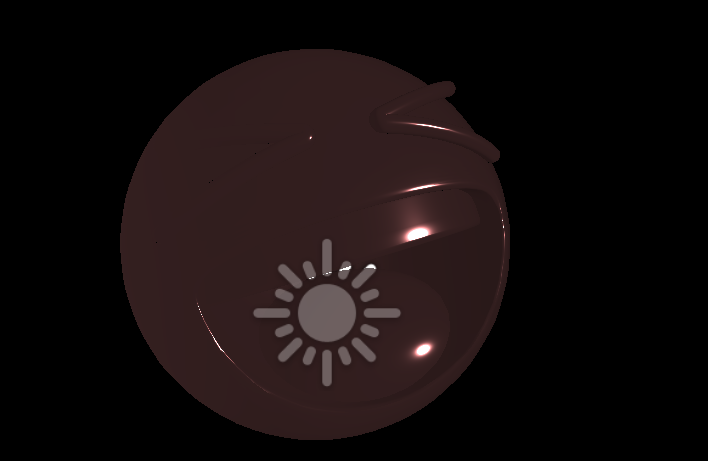
在Unity中表现:
代码:
Shader "Disney"

{

    Properties

    {

        baseColor("Base Color",Color)=(1,1,1,1)

        metallic ("Metallic", Range (0.0,1.0)) = 0.0

        subsurface ("Subsurface", Range (0.0,1.0)) = 0.0

        _specular ("Specular", Range (0.0,1.0)) = 0.0

        roughness ("Roughness", Range (0.0,1.0)) = 0.5

        specularTint ("SpecularTint", Range (0.0,1.0)) = 0.0

        anisotropic ("Anisotropic", Range (0.0,1.0)) = 0.0

        sheen ("Sheen", Range (0.0,1.0)) = 0.0

        sheenTint ("SheenTint", Range (0.0,1.0)) = 0.5

        clearcoat ("Clearcoat", Range (0.0,1.0)) = 0.0

        clearcoatGloss ("ClearcoatGloss", Range (0.0,1.0)) = 1.0

    }

    SubShader

    {

        Pass

        {

            CGPROGRAM

            #pragma vertex VSMain

            #pragma fragment PSMain


            float3 baseColor;

            float metallic, subsurface, _specular, roughness, specularTint, anisotropic, sheen,

            sheenTint, clearcoat, clearcoatGloss;


            static const float PI = 3.14159265358979323846;


            float sqr(float x) { return x*x; }


            float SchlickFresnel(float u)

            {

                float m = clamp(1.0-u, 0.0, 1.0);

                float m2 = m*m;

                return m2*m2*m; // pow(m,5)

            }


            float GTR1(float NdotH, float a)

            {

                if (a >= 1.0) return 1.0/PI;

                float a2 = a*a;

                float t = 1.0 + (a2-1.0)*NdotH*NdotH;

                return (a2-1.0) / (PI*log(a2)*t);

            }


            float GTR2(float NdotH, float a)

            {

                float a2 = a*a;

                float t = 1.0 + (a2-1.0)*NdotH*NdotH;

                return a2 / (PI * t*t);

            }


            float GTR2_aniso(float NdotH, float HdotX, float HdotY, float ax, float ay)

            {

                return 1.0 / (PI * ax*ay * sqr( sqr(HdotX/ax) + sqr(HdotY/ay) + NdotH*NdotH ));

            }


            float smithG_GGX(float NdotV, float alphaG)

            {

                float a = alphaG*alphaG;

                float b = NdotV*NdotV;

                return 1.0 / (NdotV + sqrt(a + b - a*b));

            }


            float smithG_GGX_aniso(float NdotV, float VdotX, float VdotY, float ax, float ay)

            {

                return 1.0 / (NdotV + sqrt( sqr(VdotX*ax) + sqr(VdotY*ay) + sqr(NdotV) ));

            }


            float3 mon2lin(float3 x)

            {

                return float3(pow(x[0], 2.2), pow(x[1], 2.2), pow(x[2], 2.2));

            }


            float3 BRDF( float3 L, float3 V, float3 N, float3 X, float3 Y )

            {

                float NdotL = max(dot(N,L),0.0);

                float NdotV = max(dot(N,V),0.0);


                float3 H = normalize(L+V);

                float NdotH = max(dot(N,H),0.0);

                float LdotH = max(dot(L,H),0.0);


                float3 Cdlin = mon2lin(baseColor);

                float Cdlum = .3*Cdlin[0] + .6*Cdlin[1]  + .1*Cdlin[2]; // luminance approx.


                float3 Ctint = Cdlum > 0.0 ? Cdlin/Cdlum : float3(1.0,1.0,1.0); // normalize lum. to isolate hue+sat

                float3 Cspec0 = lerp(_specular*.08*lerp(float3(1.0,1.0,1.0), Ctint, specularTint), Cdlin, metallic);

                float3 Csheen = lerp(float3(1.0,1.0,1.0), Ctint, sheenTint);


                // Diffuse fresnel - go from 1 at normal incidence to .5 at grazing

                // and lerp in diffuse retro-reflection based on roughness

                float FL = SchlickFresnel(NdotL), FV = SchlickFresnel(NdotV);

                float Fd90 = 0.5 + 2.0 * LdotH*LdotH * roughness;

                float Fd = lerp(1.0, Fd90, FL) * lerp(1.0, Fd90, FV);


                // Based on Hanrahan-Krueger brdf approximation of isotropic bssrdf

                // 1.25 scale is used to (roughly) preserve albedo

                // Fss90 used to "flatten" retroreflection based on roughness

                float Fss90 = LdotH*LdotH*roughness;

                float Fss = lerp(1.0, Fss90, FL) * lerp(1.0, Fss90, FV);

                float ss = 1.25 * (Fss * (1.0 / (NdotL + NdotV) - .5) + .5);


                // specular

                float aspect = sqrt(1.0-anisotropic*.9);

                float ax = max(.001, sqr(roughness)/aspect);

                float ay = max(.001, sqr(roughness)*aspect);

                float Ds = GTR2_aniso(NdotH, dot(H, X), dot(H, Y), ax, ay);

                float FH = SchlickFresnel(LdotH);

                float3 Fs = lerp(Cspec0, float3(1.0,1.0,1.0), FH);

                float Gs  = smithG_GGX_aniso(NdotL, dot(L, X), dot(L, Y), ax, ay);

                Gs *= smithG_GGX_aniso(NdotV, dot(V, X), dot(V, Y), ax, ay);


                // sheen

                float3 Fsheen = FH * sheen * Csheen;


                // clearcoat (ior = 1.5 -> F0 = 0.04)

                float Dr = GTR1(NdotH, lerp(.1,.001,clearcoatGloss));

                float Fr = lerp(.04, 1.0, FH);

                float Gr = smithG_GGX(NdotL, .25) * smithG_GGX(NdotV, .25);


                return (lerp(Fd, ss, subsurface)*Cdlin + Fsheen) * (1.0-metallic) + Gs*Fs*Ds + .25*clearcoat*Gr*Fr*Dr;

            }


            void VSMain (inout float4 vertex:POSITION, inout float2 uv:TEXCOORD0, inout float3 normal:NORMAL, inout float4 tangent:TANGENT, out float3 world:TEXCOORD1)

            {

                world = mul(unity_ObjectToWorld, vertex).xyz;

                vertex = UnityObjectToClipPos(vertex);

            }


            float4 PSMain (float4 vertex:POSITION, float2 uv:TEXCOORD0, float3 normal:NORMAL, float4 tangent:TANGENT, float3 world:TEXCOORD1) : SV_TARGET

            {

                float3 LightDirection = normalize(lerp(_WorldSpaceLightPos0.xyz, _WorldSpaceLightPos0.xyz - world, _WorldSpaceLightPos0.w));

                float3 NormalDirection = normalize(mul((float3x3)unity_ObjectToWorld,normal));

                float3 ViewDirection = normalize(_WorldSpaceCameraPos.xyz - world);

                float3 WorldTangent = mul((float3x3)unity_ObjectToWorld,tangent.xyz);

                float3 WorldBinormal = cross(NormalDirection,WorldTangent)*tangent.w;

                return float4(BRDF( LightDirection, ViewDirection, NormalDirection, WorldTangent, WorldBinormal), 1.0);

            }

            ENDCG

        }

    }

}
在Unity中显示的是光滑平整的,在Cocos中显示的有棱角
测试中发现与 v_tangent 和 v_bitangent两个切线向量有关。

请问下Cocos 和 Unity的切线向量有区别吗