Dispatch 没有 绑定GLOBAL set!!!修复renderer\pipeline\custom\NativeExecutor.cpp
void begin(const Dispatch& dispatch, RenderGraph::vertex_descriptor vertID) const {
    std::ignore = vertID;
    auto& programLib = *ctx.programLib;
    CC_EXPECTS(dispatch.material);
    CC_EXPECTS(dispatch.material->getPasses());
    // get pass
    auto& pass = *dispatch.material->getPasses()->at(static_cast<size_t>(dispatch.passID));
    // get shader
    auto& shader = *pass.getShaderVariant();
    // get pso
    auto* pso = programLib.getComputePipelineState(
        pass.getDevice(), pass.getPhaseID(), pass.getProgram(), pass.getDefines(), nullptr);
    CC_EXPECTS(pso);
    //        auto* perInstanceSet = ctx.perInstanceDescriptorSets.at(vertID);
    // execution
    ctx.cmdBuff->bindPipelineState(pso);
    // 强制绑 GLOBAL set,从当前 node 的 PER_PASS 数据中取
    {
        const DescriptorSetKey pkey{vertID, UpdateFrequency::PER_PASS};
        auto piter = ctx.ppl->nativeContext.graphNodeDescriptorSets.find(pkey);
        if (piter != ctx.ppl->nativeContext.graphNodeDescriptorSets.end()) {
            ctx.cmdBuff->bindDescriptorSet(
                static_cast<uint32_t>(pipeline::SetIndex::GLOBAL), piter->second);
        }
    }
    ctx.cmdBuff->bindDescriptorSet(
        static_cast<uint32_t>(pipeline::SetIndex::MATERIAL), pass.getDescriptorSet());
    //        ctx.cmdBuff->bindDescriptorSet(
    //            static_cast<uint32_t>(pipeline::SetIndex::LOCAL), perInstanceSet);
    ctx.cmdBuff->dispatch(gfx::DispatchInfo{
        dispatch.threadGroupCountX,
        dispatch.threadGroupCountY,
        dispatch.threadGroupCountZ,
    });
}
重新编译模拟器后 跟着文档抄一遍
private buildRayTracingComputePass(
    camera: renderer.scene.Camera,
    pipeline: rendering.Pipeline,
    cameraConfigs: CameraConfigs,
) {
    const rtMat = cameraConfigs.settings.rayTracingComputePass.rtMat;
    if (!rtMat) return '';

    const width = camera.window.width;
    const height = camera.window.height;
    const csOutput = 'rt_output';
    if (!pipeline.containsResource(csOutput)) {
         pipeline.addStorageTexture(csOutput,
         gfx.Format.RGBA8,width, height,
         rendering.ResourceResidency.MANAGED);
    }else{
         pipeline.updateStorageTexture(csOutput,
         width, height,gfx.Format.RGBA8);
    }

    // compute pass
    const cs = pipeline.addComputePass('user-ray-tracing');
    cs.setMat4('projectInverse', camera.matProjInv);
    cs.addStorageImage(csOutput, rendering.AccessType.WRITE, 'outputImage');
    cs.addQueue()
        .addDispatch(Math.ceil(width / 8), Math.ceil(height / 4), 1, rtMat);
    return csOutput;
}

shader:
CCEffect %{
  techniques:
  - name: opaque
    passes:
    - compute: compute-main
      pass: user-ray-tracing
}%

CCProgram compute-main %{
  precision highp float;
  precision mediump image2D;

layout(local_size_x = 8, local_size_y = 4, local_size_z = 1) in;


#pragma rate constants pass
uniform constants {
  mat4 projectInverse;
};

#pragma rate outputImage pass
layout (rgba8) writeonly uniform image2D outputImage;

void main () {
  vec3 spherePos = vec3(0, 0, -5);
  vec3 lightPos = vec3(1, 1, -3);
  vec3 camPos = vec3(0, 0, 0);
  float sphereRadius = 1.0;
  vec4 color = vec4(0, 0, 0, 0);
  ivec2 screen = imageSize(outputImage);
  ivec2 coords = ivec2(gl_GlobalInvocationID.x, gl_GlobalInvocationID.y);
  vec2 uv = vec2(float(coords.x) / float(screen.x), float(coords.y) / float(screen.y));
  vec4 ndc = vec4(uv * 2.0 - vec2(1.0), 1.0, 1.0);
  vec4 pos = projectInverse * ndc;
  vec3 camD = vec3(pos.xyz / pos.w);
  vec3 rayL = normalize(camD - camPos);
  vec3 dirS = spherePos - camPos;
  vec3 rayS = normalize(dirS);
  float lenS = length(dirS);
  float dotLS = dot(rayL, rayS);
  float angle = acos(dotLS);
  float projDist = lenS * sin(angle);
  if (projDist < sphereRadius) {
    // intersection
    vec3 rayI = rayL * (lenS * dotLS - sqrt(sphereRadius * sphereRadius - projDist * projDist));
    vec3 N = normalize(rayI - dirS);
    vec3 L = normalize(lightPos - rayI);
    color = vec4(vec3(max(dot(N, L), 0.05)), 1.0);
  }
  imageStore(outputImage, coords, color);
}
}%
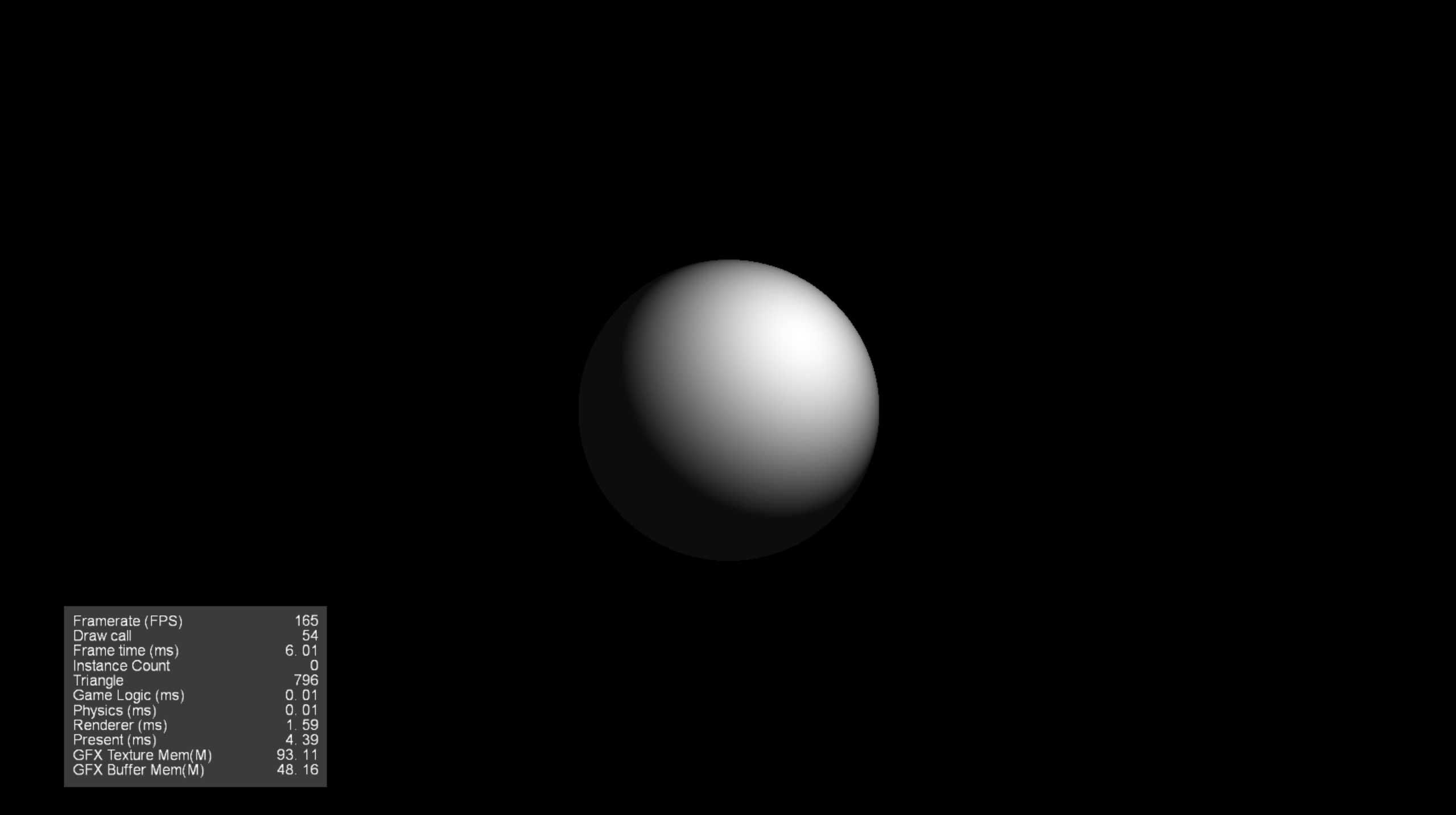
就能显示光追小球了: